The Institute of Economic Affairs (IEA) has dismissed claims that the Ghana Gold Board (GoldBod) incurred a GH¢1.7 billion loss under the Bank of Ghana’s Domestic Gold Purchase Programme.
According to the IEA, a large share of that amount reflects revenue items and foreign-exchange valuation differences rather than an actual financial loss for the Gold Board.
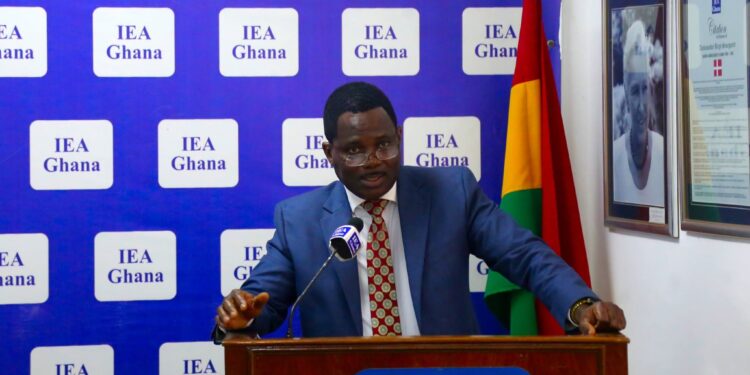
Professor Alexander Bilson Darku, IEA’s Director of Research, rejected the characterisation. He explained that the reported sum includes service fees, assaying fees and exchange-rate valuation gaps linked to GoldBod’s buying and export activities.
The service and assaying fees, he noted, are payments from the Bank of Ghana to GoldBod for work performed on the central bank’s behalf and therefore count as income for GoldBod.
“I don’t understand why somebody would call revenue a loss,” Prof. Darku said during the IEA’s review of the 2026 mid-year budget, held under the theme “From Stabilisation to Transformation: An Assessment of Ghana’s 2026 Mid-Year Budget Review.”
He pointed out that roughly 90 per cent of the GH¢1.7 billion figure stems mainly from exchange-rate valuation effects. GoldBod buys gold for the Bank of Ghana, after which the proceeds are converted from US dollars into cedis at the central bank’s reference rate.
Any gap between the rate used at purchase and the rate applied when the proceeds are valued can show up as a loss in the Bank of Ghana’s accounts, even though it does not necessarily reduce national wealth.
“It is merely a book accounting issue, and not a significant loss to the nation,” he stated.
Prof. Darku added that transactions between the two public bodies should be considered from the wider government standpoint: a cost recorded by one entity can appear as revenue for the other.
“To the Government, its monetary authority, which is the Central Bank, has made that loss. To the Government, its Gold Board has made that gain,” he observed, noting that the amounts can effectively cancel out at the consolidated government level.
At the same time, he stressed that GoldBod’s finances still need close examination, especially as the agency shifts from Bank of Ghana funding to private-sector sources for its gold purchases. If managed well, the new financing approach could strengthen Ghana’s capital markets, but it will require transparency, prudent financial controls and robust oversight.
Prof. Darku also recognised GoldBod’s positive economic role, including higher gold exports, greater foreign-exchange inflows and stronger reserves. These have helped support the cedi’s appreciation and overall stability, which in turn can lower import costs, ease inflation and interest rates, improve the debt-to-GDP ratio and enhance the country’s ability to service foreign-currency debt.
He warned, however, against over-dependence on gold for exchange-rate stability and reserve build-up. The government should also promote broader exports, encourage import substitution, regulate the foreign-exchange market more effectively and increase local ownership of economic activity.
Commending the authorities for notable macroeconomic stabilisation, he said the next challenge is to turn those gains into lasting growth, jobs and structural transformation.
“The IEA thinks that the Government has done well to achieve some reasonable macroeconomic stability, and most of the macro-indicators have moved in the right direction within a relatively short period of time,” Prof. Darku remarked.
“The question is whether we have the courage to consolidate those gains into lasting economic transformation that includes the lives of every Ghanaian.”
To that end, he called for greater investment in agriculture, employment-driven growth, more local processing of natural resources, reforms to the natural-resource regime, and a shift of GoldBod from a pure gold trader into a strategic asset manager.
He further urged stronger enforcement powers for the Fiscal Council and steps to ensure that cuts in the monetary policy rate feed through into lower lending rates for businesses and the private sector.